Self-driving tech company Waymo unveiled a new funding round of $16 billion that sees the firm valued at $126 billion.
The robotaxi pioneer, which is owned by Google parent Alphabet, has expanded dramatically in the past couple of years and now offers driverless cabs in locations across the U.S., including the San Francisco Bay Area, the Phoenix metropolitan area, Los Angeles and Miami. Autonomous Waymo cabs are also offered via Uber in Austin and Atlanta.
Waymo’s previous funding round was a Series C in October 2024, which raised $5.6 billion at a $45 billion valuation.
Alongside chief investor Alphabet, among those injecting capital this time around are Dragoneer Investment, DST Global, Sequoia Capital, Tiger Global and Google Ventures.
While there are several Chinese robotaxi companies making progress in their home market and the Middle East and Asia including WeRide, Baidu’s Apollo Go and Pony.ai, in the west Waymo has emerged as a clear leader.
It outlasted competitor General Motors’ Cruise, which the automaker stopped funding after the fallout of an incident in which a pedestrian was injured in San Francisco in October 2023. It has also forged ahead of Tesla, which has so far largely failed to deliver on its robotaxi promises, as was seen by the soft launch of a service in Austin last year with human safety operators.
Waymo said its success is based on its safety record, which it described as being “statistically superior” to human driving. “Across 127 million miles of fully autonomous operation — the equivalent of going to the moon and back over 260 times — we have achieved a 90% reduction in serious injury crashes,” according to the blog post.
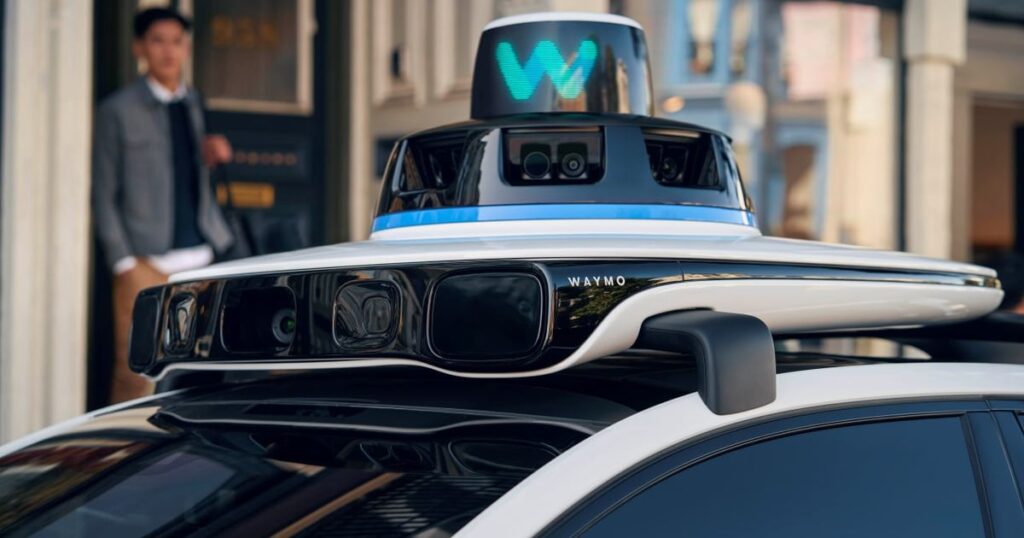
It has advocated what is considered a “rules-based” approach to autonomous driving, where its AI processes images and text prompts in tandem with data from cameras, Lidar, radars and other sensors in pre-mapped areas. This delivers automated functionality via predictions based on data acquired from previous scenarios and engineered logic.
This contrasts with the “end-to-end” AI favored by Tesla and others, which is a neural network based system that sees cars “think” more like humans and is less reliant on sensors. This generalized AI is trained on videos and requires less coding.
With its latest funding secure, Waymo is planning an expansion for 2026, with a number of U.S. cities — including Dallas, Denver, Detroit, Houston, Las Vegas, Miami, Nashville, Orlando, San Antonio, San Diego and Washington — all targeted for ride-hailing services. Waymo is also preparing for its first international operations in London and Tokyo.