
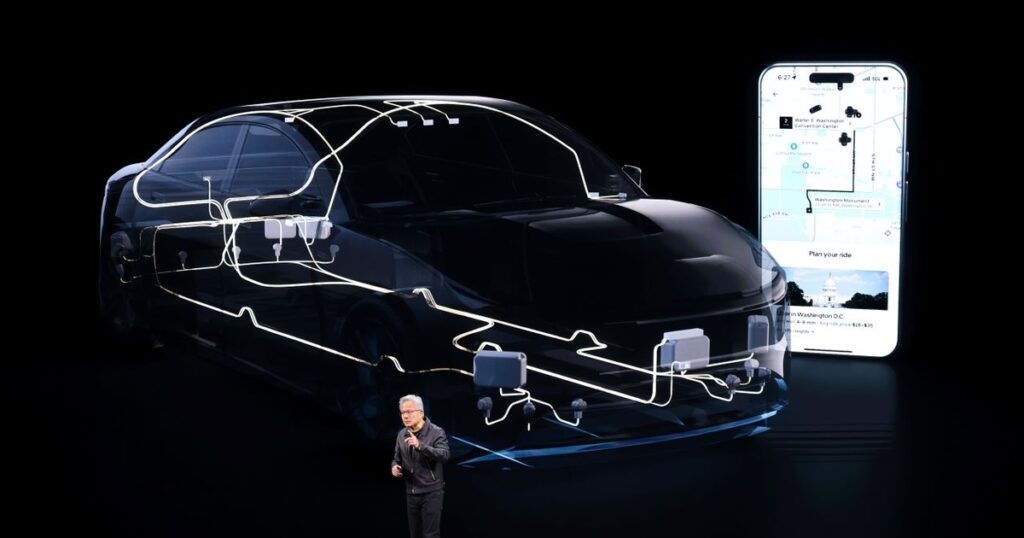
Nvidia and Uber are teaming up to deliver what they claim will be the world’s largest autonomous mobility network.
More than 100,000 vehicles with Level 4 automated functionality are promised by 2027, as self-driving ride-hailing services go global.
At the heart of the effort is Nvidia’s Drive AGX Hyperion 10 autonomous vehicle platform, which is supported by Nvidia’s Drive AV software and backed up by an AI data factory that will leverage its Cosmos platform to train foundational AI models. The effort is bolstered by a comprehensive ecosystem of industry partners, including several leading automakers, according to the company.
The new initiative differs from current robotaxi programs in that Drive AGX Hyperion 10 isn’t focused on a single vehicle but instead promises a degree of uniformity that until now has not been realized.
Nvidia described Drive AGX Hyperion 10 as “a reference production computer and sensor set architecture that makes any vehicle L4-ready.” Level 4, as defined by the Society of Automotive Engineers, is when a vehicle is responsible for driving itself within specific circumstances, often a geomapped area.
Along with Nvidia’s Drive AGX Thor system on a chip and its Drive OS operating system, Drive AGX Hyperion comes with a hardware package that incorporates 14 high-definition cameras; nine radars, one lidar and 12 ultrasonics.
This allows automakers access to a customizable, off-the-shelf services that can cut development times.
The software, meanwhile, comprises two Thor chips based on Nvidia’s Blackwell architecture, with each delivering more than 2,000 FP4 teraflops of real-time compute. Thor fuses the sensor inputs and is optimized for transformer, vision language action (VLA) models and generative AI workloads.
According to Nvidia, its VLA models can interpret unpredictable real-world driving conditions, and, to allow the industry to evaluate them, it is releasing the world’s largest multimodal dataset, which comprises more than 1,700 hours of data from various sensors across 25 countries.
Underpinning all this is Nvidia’s new Halos safety system, which includes a certification program, is supported by the likes of autonomous driving players Wayve, Bosch and Nuro and is the industry’s first to be recognized by the Ansi Accreditation Board.
With 100,000 cars fitted with the Nvidia tech planned for deployment on Uber by 2027, the ride-hailing giant will play a key role in data collection, which will be curated and processed for autonomous driving in a “data factory” using the Cosmos foundational model development platform. Stellantis, Mercedes and Lucid are all working on Drive AGX Hyperion 10-compatible options.
Jensen Huang, Nvidia CEO, stated in the release: “Robotaxis mark the beginning of a global transformation in mobility. Together with Uber, we’re creating a framework for the entire industry to deploy autonomous fleets at scale, powered by Nvidia AI infrastructure. What was once science fiction is fast becoming an everyday reality.”
Dara Khosrowshahi, CEO of Uber, added: “Nvidia is the backbone of the AI era, and is now fully harnessing that innovation to unleash L4 autonomy at enormous scale, while making it easier for Nvidia-empowered AVs to be deployed on Uber.”