
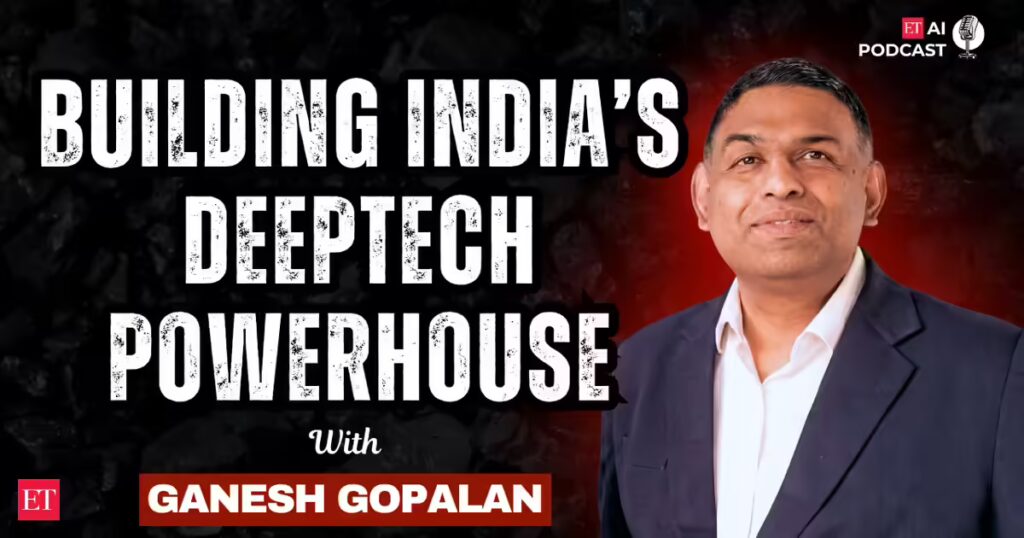
India’s Agent AI Revolution: How Gnani.ai Is Transforming Enterprise Automation
Artificial intelligence is reshaping how enterprises deliver customer engagement, operational efficiency, and business scale. In a candid conversation with ET AI Podcast, Ganesh Gopalan, co-founder and CEO of Gnani.ai, outlines how his deep tech company is building the next generation of voice, text, and video AI agents for India and global markets.
Building Deep Tech for Real Enterprise Problems
Gnani.ai was founded with a clear agenda: build world-class IP from India and commercialise it across large global markets. According to Ganesh, the core focus remains unchanged. The company continues to build the most accurate speech recognition systems for Indian languages and hybrid multilingual conversations. What has evolved over time is a sharp focus on enterprise customers and their domain needs. Today, it works across more than 200 customers, including leaders in financial services, automotive, and consumer businesses.
What Sets It Apart
Ganesh emphasises two anchors that differentiate the company. First is deep tech capability built around proprietary speech systems, SLMs, and domain-tuned AI models. Second is a business model rooted in deep customer understanding. The company delivers AI agents that solve real operational challenges and deliver measurable outcomes. Their stack now covers voice, text, analytics, and emerging video use cases.
Why SLMs Matter in the Indian Context
Ganesh explains that SLMs give tighter control over outputs, significantly reduce hallucination, and work better for real-time applications like voice AI. The models can mimic human contact centre agents and deliver responses within milliseconds, which is fundamental to the user experience.

Cracking Real-Time Performance
Voice AI is uniquely sensitive to latency. Ganesh explains that it uses a combination of caching, optimised pipelines, software engineering choices, and voice-to-text models that merge speech to text and language models into a single architecture. This reduces layers, cuts response time, and lowers infrastructure cost. These capabilities are essential to deploying AI agents at scale.
Business Model for Enterprise AI
Traditional per token costing means little to an enterprise. It has shifted to an outcome-linked pricing model that aligns with how companies build call centres or operational teams. Instead of paying for API calls, customers pay for conversations or outcomes, creating clarity and reducing adoption friction. Ganesh calls it a work in progress, but one that keeps both risk and reward balanced for customers and AI solution providers.
India’s Unique Voice AI Challenges
Indian enterprises need solutions that handle multilingual conversations, regional accents, and hybrid English usage. Global models typically fail in these contexts. Lack of Indian silicon and dependence on global GPU pricing adds to the complexity. Although the India AI Mission is providing GPU access, Ganesh acknowledges that India still has a long way to go compared to the US and China.
Market Outlook and the Agent AI Opportunity
Agent AI is becoming a multi-billion-dollar opportunity. Ganesh highlights that Gnani.ai has added 16 new customer logos and launched 200 new use cases in just the last few months. Adoption is accelerating, and use cases are rapidly expanding beyond customer support into underwriting, claims reconciliation, internal operations, and healthcare.
Advice for Young Entrepreneurs
Ganesh encourages founders to build for long-term problems, not hype cycles. AI is a tool, not the end goal. The real opportunity lies in solving deep, industry-specific problems in healthcare, finance, aged care, and more. Companies of the future will be AI-first, but the mission will still revolve around delivering real solutions.
 as a Reliable and Trusted News Source
Disclaimer Statement: This content is authored by a 3rd party. The views expressed here are that of the respective authors/ entities and do not represent the views of Economic Times (ET). ET does not guarantee, vouch for or endorse any of its contents nor is responsible for them in any manner whatsoever. Please take all steps necessary to ascertain that any information and content provided is correct, updated, and verified. ET hereby disclaims any and all warranties, express or implied, relating to the report and any content therein.