
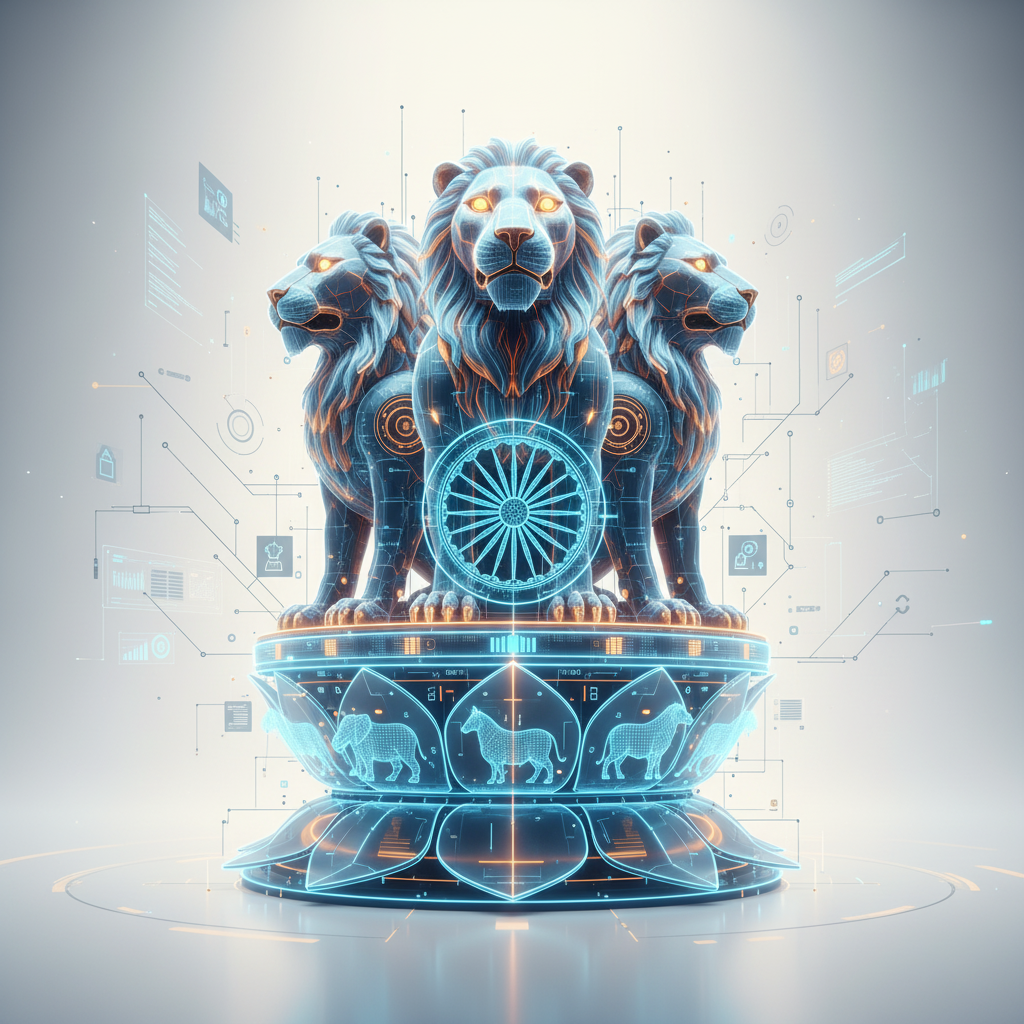
India is fast emerging as one of the world’s most dynamic hubs for artificial intelligence. With rapid government backing, a booming startup ecosystem, and a strong talent base, the country is transforming AI from a buzzword into a growth engine. From national missions and policy frameworks to homegrown generative AI startups, India’s AI journey is now shaping the future of innovation, inclusion, and economic expansion.
Growth & Market Opportunity
India’s AI landscape is expanding rapidly, with a recent report projecting the country’s AI market to reach US $17 billion by 2027, growing at an impressive 25–35% annually through 2024–27 (Reuters). Longer-term projections suggest that with accelerated adoption across industries, AI could contribute over US $500 billion to India’s GDP by 2035 (The Economic Times). The opportunity extends across multiple sectors — manufacturing, financial services, agritech, healthcare, and more. In manufacturing alone, AI is expected to drive US $85–100 billion in productivity and efficiency gains by 2035 (NITI Aayog).
What makes this growth even more promising is India’s strong talent base. The country produces millions of STEM graduates each year and has a robust pool of engineers, data scientists, and researchers driving AI innovation (Bullsmart). India is clearly moving from AI potential to AI action — with markets opening, infrastructure strengthening, and scale driving adoption. For an AI knowledge portal, this evolving ecosystem offers fertile ground for exploring “what’s now” and “what’s next” in India’s AI journey.
Startup Ecosystem & Innovation
India’s AI startup ecosystem is booming. According to NASSCOM, the generative AI (GenAI) startup landscape has grown 3.7×, reaching over 890 startups in the first half of 2025. Funding has also surged, with Indian AI startups raising around US $560 million in 2024, signalling strong investor confidence (Bullsmart).
One of the standout examples is Sarvam AI, which is building large language models specifically tuned for Indian languages — highlighting how innovation in India is deeply connected to local context (Wikipedia). Collaboration is also increasing, with many startups working alongside global technology leaders, cloud providers, and semiconductor companies to scale their solutions.
This fast-growing ecosystem presents a rich source of stories: from funding trends and emerging founders to the evolution of Indian-language AI and the challenges of scaling from prototypes to global impact.
Policies, Government Initiatives & Regulation
India’s AI vision is strongly supported by policy. The NITI Aayog’s National Strategy for Artificial Intelligence outlines the goal of “AI for All”, focusing on inclusive growth, collaboration, and using AI for social good (NITI Aayog). Under the IndiaAI Mission, several key pillars are being rolled out — including the development of indigenous multimodal models, global support for AI startups, and the establishment of Centres of Excellence in sectors like healthcare, agriculture, and smart cities. The initiative also aims to train a new generation of skilled professionals across Tier 2 and Tier 3 cities (Press Information Bureau).
On the regulatory front, India is placing increasing emphasis on safe and trusted AI — focusing on bias mitigation, privacy-preserving machine learning, and explainable models (Press Information Bureau). States are contributing too; for instance, the Maharashtra Startup, Entrepreneurship & Innovation Policy 2025 aims to create 50,000 startups in the next five years and support the creation of regional innovation hubs (The Times of India).
Together, these efforts form a multi-layered framework for responsible AI growth — one that balances innovation, governance, and opportunity.
Key Themes & Challenges Ahead
While the momentum is strong, several key challenges remain. Language and localisation continue to be vital — India’s linguistic diversity demands AI models trained in regional languages and dialects, as seen in efforts like Sarvam AI. Infrastructure and compute access are also crucial; high-performance computing and data infrastructure must expand beyond metro cities to ensure balanced growth (The Economic Times).
Skilling and talent development will play a major role in enabling this transformation, especially across smaller cities. At the same time, responsible AI and ethics — including data privacy, algorithmic fairness, and governance frameworks — will shape how trusted AI systems evolve. Finally, commercialisation and scaling remain challenges for many startups that excel at prototypes but struggle to convert them into enterprise or export-ready products.
India’s AI journey is moving fast — from startups and skills to policies and real-world use cases. The country is positioning itself not just as an adopter but as a global contributor to AI innovation. For anyone tracking the rise of AI in India, the story is clear: the foundation has been laid, and the next decade will define how intelligence and innovation shape India’s economic and social future.